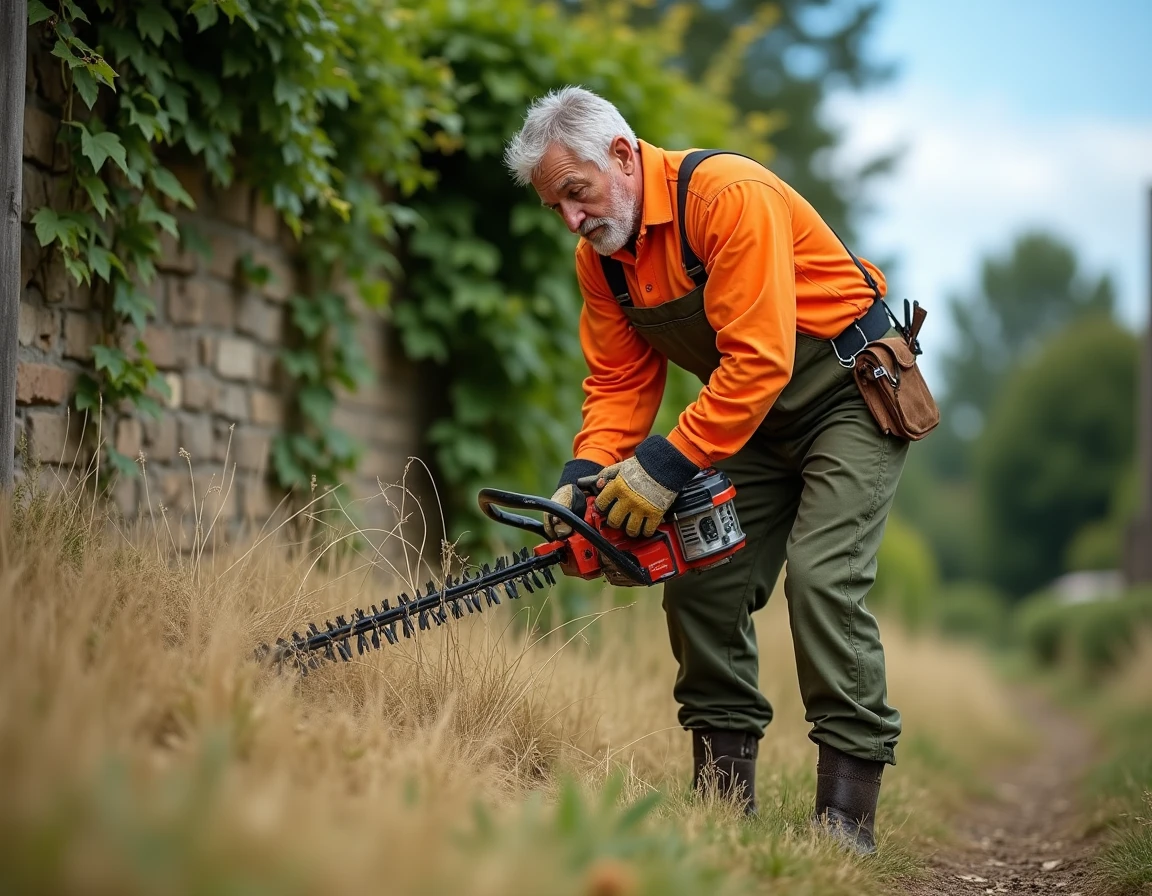
The market for thermal brush cutters remains broad, with varying engine sizes, cutting systems, and comfort levels from one model to another. Product sheets highlight the engine power and cutting width, but they often remain silent on a crucial point: what the machine does to the body after half an hour of actual use.
Vibrations, harness, and fatigue: what changes after thirty minutes of brush cutting
Most buying guides classify thermal brush cutters by engine size or type of motorization. These criteria matter, but they say nothing about the user’s physical experience over time.
A machine with a properly running engine can become cumbersome if the anti-vibration system is basic. The vibrations transmitted to the hands and forearms cause rapid muscle fatigue, and during prolonged sessions, numbness. Manufacturers offer silent blocks or decoupling systems between the engine and the handle, but their effectiveness varies significantly from one model to another.
The harness plays a comparable role. A simple harness poorly distributes weight, putting strain on the shoulder and back on the dominant side. Double-strap harnesses, with a lumbar belt and back plate, transfer the load to the pelvis. On sloped or uneven terrain, the difference is felt within the first few minutes. Several models offered on top-debroussailleuse-thermique.com detail these comfort features, often absent from standard technical sheets.
The comfort of use determines the quality of work as much as the engine power. A tired user cuts poorly, forces the machine, and exposes themselves to imprecise movements.
Engine size and cycle of a thermal brush cutter: beyond raw numbers
Engine size remains the primary selection filter. A modest engine size is suitable for the regular maintenance of a garden where the grass does not exceed a certain height. For brambles, woody shoots, or neglected land, a larger engine size is necessary, which also implies greater weight and bulk.
The choice between a two-stroke engine and a four-stroke engine deserves attention. The two-stroke dominates the market due to its lightness and cost. The four-stroke, less common in brush cutters, consumes less and produces fewer exhaust gases, but it is generally heavier.
Field feedback varies on this point: some users prefer the immediate torque of a two-stroke for tackling dense areas, while others favor the more consistent operation of a four-stroke for longer sessions. The available data does not allow for a conclusion that one type consistently outperforms the other for mixed residential use.
What engine size does not tell you
A powerful engine paired with a poorly sized transmission or a fragile bevel gear will not last over time. The size of the bevel gear determines the mechanical resistance of the machine against hard vegetation. This component, located at the junction between the pole and the cutting head, endures all the twisting stresses. Entry-level models often skimp on this part.
Cutting system: line, blade, or disc depending on the actual vegetation on your land
The suitable cutting system directly depends on what is growing on the land, not on an abstract preference.
- The line head is suitable for soft grasses, finishing along edges, and areas near obstacles (walls, trees, fences). The line breaks upon contact with a hard element, protecting the machine and the immediate environment.
- The three or four-tooth blade tackles tall, dry grasses, dense nettles, and young woody shoots. It requires sufficient clearance around the work area.
- The tungsten disc or circular blade is aimed at thick brambles, shrub shoots, and dense undergrowth. This type of tool requires a machine with sufficient engine size and an appropriate harness.
Some models are sold with both line and blade, providing immediate versatility without additional purchase. The Stihl FS 55, for example, is offered with these two accessories. In contrast, a model delivered only with a line head will require an additional investment if the terrain has areas of dense vegetation.

Weight, price, and maintenance: the concrete trade-offs before purchase
The weight of the machine, including the harness, directly influences the duration of comfortable use. A difference of a few hundred grams is strongly felt after half an hour. The most powerful models logically weigh more, necessitating a trade-off between cutting capacity and the user’s physical endurance.
The purchase price reflects only part of the actual cost. Maintaining a thermal brush cutter involves regular replacement of filters, spark plugs, line, or blades, as well as preparing the oil-gas mixture for two-stroke engines. These constraints, minor when considered in isolation, accumulate over a full season.
Some points to check before finalizing a choice
- The type of harness supplied with the machine (simple harness or ergonomic double-strap harness)
- The availability of spare parts and consumables in the local distribution network
- The presence of an identifiable anti-vibration system on the technical sheet, not just a marketing mention
- The cutting accessories provided: a model supplied with line and blade covers more situations than a model supplied with line only
The best thermal brush cutter for a given garden is not the most powerful in the catalog. It is the one whose weight, carrying comfort, and cutting system match the actual terrain and the physical condition of the person who will use it each month of the season.