A sports coach is a professional who designs and supervises training programs tailored to a physiological profile, a level of practice, and a specific goal. The term encompasses very different realities depending on the diploma held, the format of the sessions, and the practitioner’s specialization. Choosing the right coach relies less on perceived likability than on a methodical verification of technical and regulatory criteria.
State diploma or CQP: what regulations require from sports coaches
The first verification to carry out concerns legal qualification. In France, paid sports coaching requires holding a diploma registered in the National Directory of Professional Certifications. The two main ones are the BPJEPS (Professional Certificate of Youth, Popular Education and Sport) and the DEJEPS for higher levels.
Since the reform of the Professional Qualification Certificates (CQP) in sports validated by the sports branch in 2022, the distinction between coaches holding a state diploma and those with only a CQP is more regulated. A coach with only a CQP cannot legally supervise certain vulnerable groups (elderly people, patients with chronic conditions).
If your goal involves returning to activity after an injury or a program related to a medical prescription, make sure the coach holds a state diploma, not just a CQP.
Every professional should be able to present their professional card issued by the Regional Directorate of Economy, Employment, Labor and Solidarity (DREETS). This document certifies the validity of the diploma and the absence of a prohibition to practice. Platforms like 1sport1coach.com allow filtering coaches based on their certifications, simplifying this verification step.
Hybrid or in-person coaching: choosing the format suited to your goals
The format of the sessions has as much impact as the coach’s competence. Since 2023, hybrid coaching (in-person, video, and follow-up via app) has become a standard offered by most platforms and gyms. This evolution changes the selection criteria.
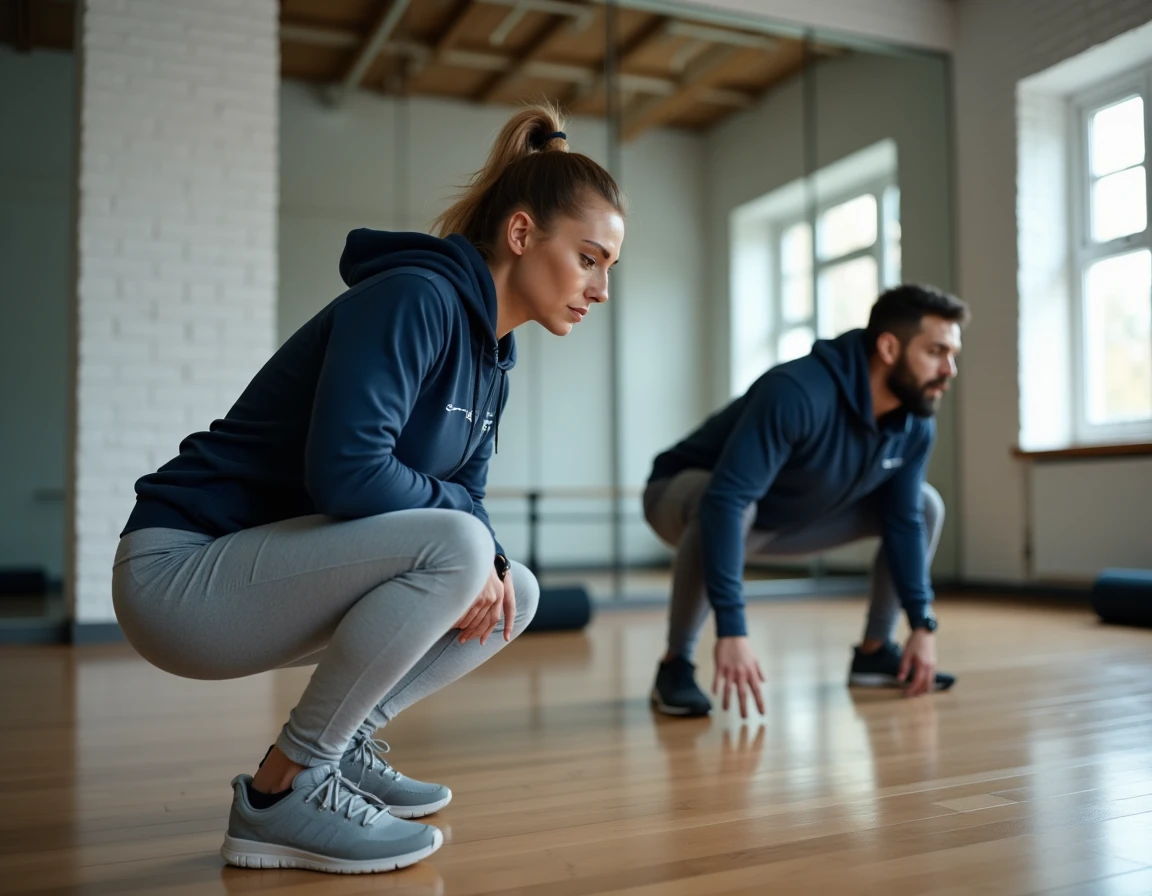
In-person training remains preferable for goals requiring real-time postural correction: weightlifting with heavy loads, functional rehabilitation, specific physical preparation for a sport. The coach observes muscle compensations, adjusts the range of movements, and intervenes on safety.
The video format is better suited for maintenance programs, weight loss, or cardio fitness, where the exercises are less technical. Several coach networks report a strong increase in demand for this format, particularly for post-pregnancy recovery or adapted physical activity programs.
Criteria to check for remote coaching
- The coach’s ability to master digital tracking tools (programming app, sharing execution videos, responsive messaging between sessions)
- The existence of an initial assessment conducted via video or in-person before starting the program, including a health questionnaire and an evaluation of physical capabilities
- The frequency of program adjustments: good remote follow-up involves modifications every two to four weeks, not a fixed plan for three months
Specialization of the sports coach: why a generalist is no longer enough
Field studies conducted by coach networks and specialized platforms since 2022 show a decrease in demand for generalist coaching. Clients are now looking for coaches specialized in a specific goal: preparation for a race, post-operative strengthening, stress management through physical activity, optimization of body composition.
This shift has a direct consequence on your search. A coach excellent in weightlifting is not necessarily competent to prepare for a trail. A weight loss specialist does not have the same tools as a performance-oriented physical trainer.
Questions to ask before committing
- What is your specific experience with clients who have the same goal as mine?
- What measurement tools do you use to evaluate progress (physical tests, load tracking, recovery indicators)?
- Do you work in a network with other health professionals (physiotherapist, dietitian) if my goal requires it?
- What is your client renewal rate, and why do your former clients stop?
The last question is rarely asked. Yet it reveals the coach’s ability to maintain motivation over time and the quality of their relationship with clients.

Trial session and first exchanges: what they really reveal
Most coaches offer a first session for free or at a reduced rate. This moment serves less to assess the intensity of the training than to observe the coach’s teaching method.
During this session, a competent coach starts by asking questions about your medical history, your physical activity habits, your schedule constraints, and your realistic expectations. A coach who proposes a program right from the first meeting without prior assessment lacks rigor.
Also observe the ability to listen. A coach who talks more than they listen during the initial assessment risks imposing a standardized program on your profile. Personalized sports coaching relies on continuous adaptation, not on a one-size-fits-all model applied to all clients.
Finally, the price is not a reliable indicator of quality. Price differences between home coaches often reflect geographical area and travel expenses more than skill level. Instead, compare the content of the support: a higher price is justified if the coach includes nutritional follow-up, weekly program adjustments, and availability between sessions to answer your questions.
The choice of a sports coach is based on three concrete filters: the regulatory compliance of the diploma, the suitability of the session format with your goal, and the verifiable specialization of the practitioner. The trial session allows for validating the last criterion, the most difficult to assess from an online profile.