
The Turmopol 20 HD is a reducer oil formulated for the mechanical and thermal demands of Hilti rotary hammers. Replacing it with a commercial product raises specific questions about viscosity, chemical compatibility, and manufacturer warranty.
ISO VG Class and Rheological Profile of Turmopol 20 HD
The Turmopol 20 HD corresponds to an industrial oil ISO VG 220 of high-performance gear oil type. This classification has nothing to do with the “20” designation in the trade name, which often misleads users on forums. We observe that many users search for an ISO VG 20 oil or a SAE 20, which directs them towards products that are far too fluid for the housing of a Hilti rotary hammer.
The expected rheological profile is that of a thick oil, capable of maintaining a stable lubricating film under very high gear loads and operating temperatures that quickly rise in a compact housing. Synthetic or PAO (polyalphaolefins) based ISO VG 220 oils are the only credible substitute family.
To delve deeper into the subject and identify a Hilti rotary hammer oil equivalent to Turmopol 20 HD, it is essential to start from this ISO VG 220 class, never from an automotive SAE equivalence.
Foaming and Aeration Issues in Hilti Housings
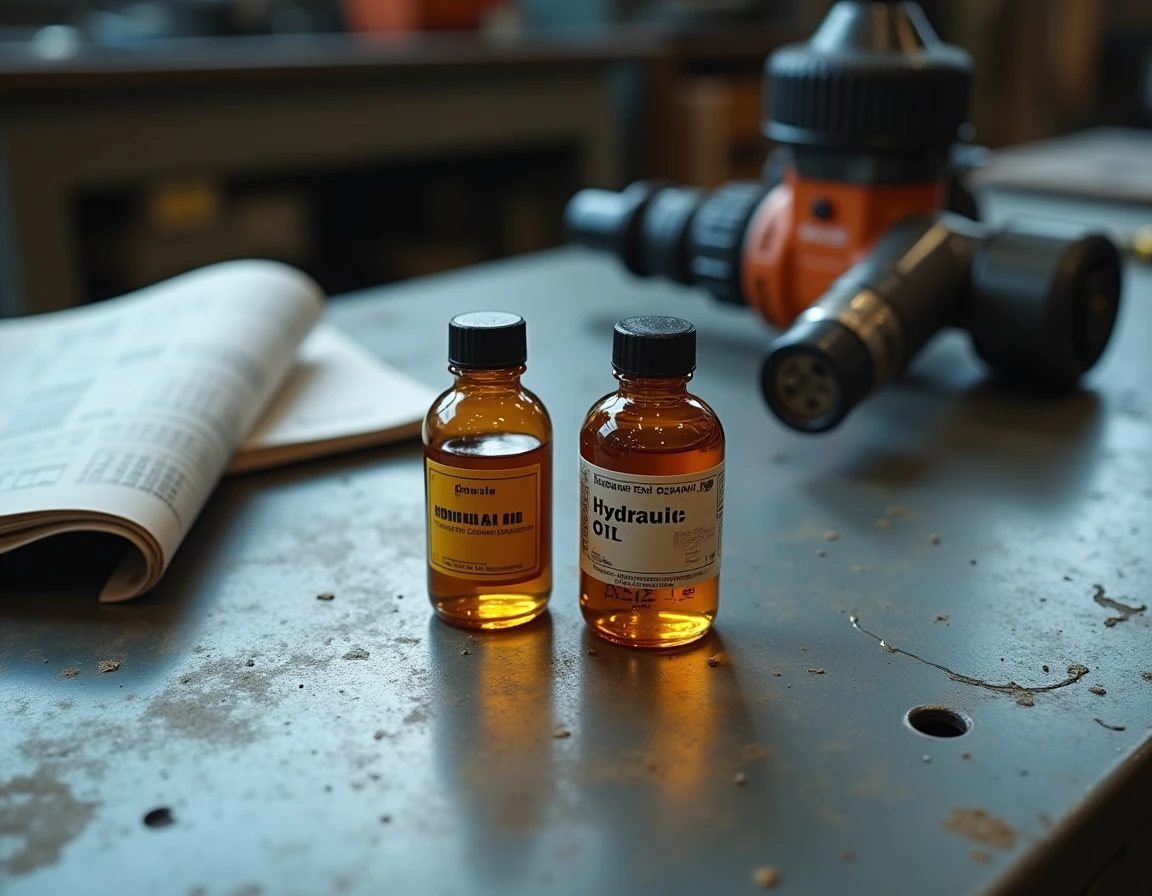
A rotary hammer housing is nothing like an automotive gearbox housing. The oil volume is small, the pinion rotation is fast, and the free space above the oil bath is limited. Under these conditions, poorly formulated oil generates foam that interrupts the lubricating film.
Feedback from professional repairers is clear: several gear oils intended for automotive or agricultural use, despite being close in nominal viscosity, have caused aeration phenomena in Hilti rotary hammers. The symptoms include abnormal transmission noise and premature gear wear.
The reason lies in the anti-foam additives. Industrial reducer oils (CLP or CKC category) incorporate anti-foam agents calibrated for small volumes and high mixing rates. Automotive GL-4 or GL-5 oils are not formulated for this type of stress.
EP Additives and Seal Compatibility
The sulfur or phosphorus extreme pressure (EP) additives in GL-5 oils can attack certain elastomers used in Hilti seals. The Turmopol 20 HD is specifically tested for its compatibility with these seals. Using an automotive GL-5 oil risks degrading the seals and causing leaks even before any gear wear is visible.
Industrial ISO VG 220 Oils Compatible with Hilti Rotary Hammers
In the absence of locally available Turmopol 20 HD, we recommend turning to synthetic or semi-synthetic industrial reducer oils in ISO VG 220 class. Three criteria should guide the choice:
- Certified viscosity ISO VG 220, measured at 40 °C according to ISO 3448 standards, and not just a marketing mention
- Synthetic PAO or poly glycol base, which offers better thermal stability and superior oxidation resistance compared to mineral bases in a compact housing
- Elastomer seal compatibility verified by the oil manufacturer (the technical data sheet must mention compatibility with common NBR and FKM seals)
References such as Mobil SHC Gear, Klüber, or Shell Omala S4 in ISO VG 220 grade meet these three requirements. These oils are designed for high-load industrial reducers, in a mechanical environment comparable to that of a heavy rotary hammer.

Hilti Warranty and Risk of Cancellation in Case of Non-Approved Oil
Hilti specifies that using non-specified oils may void the warranty and accelerate the wear of internal components. This position is documented in maintenance sheets and responses from technical support. In practice, a rotary hammer returned for service with a housing containing non-compliant oil will be inspected, and any trace of unsuitable product will be sufficient to refuse coverage.
For machines still under warranty, the only risk-free option remains the original Turmopol 20 HD or an oil explicitly validated by Hilti. Substituting with an industrial ISO VG 220 oil is only justified for out-of-warranty machines, fully aware of the transfer of responsibility.
Quantity and Filling Procedure
The oil volume varies by model. Rotary hammers from the TE 50 to TE 80 series use a pinion housing and, on certain references, a separate connecting rod reservoir. Each compartment has a volume and sometimes a distinct lubricant grade. Consult the technical documentation of the exact model before filling: excess oil in a compact housing promotes temperature rise and aeration.
- Completely drain the old oil and clean the housing before filling, especially when changing brand or chemical base
- Adhere to the level indicated by Hilti (visual marker or volume in milliliters depending on the model)
- Never mix residual mineral oil with synthetic PAO oil without prior rinsing, as this may lead to deposits
Summary of Criteria for Selecting an Equivalent Oil
The choice of a substitute for Turmopol 20 HD is based on a non-negotiable triptych: ISO VG 220, synthetic PAO base, confirmed seal compatibility. Automotive oils, including SAE 85W-140 gear oils, do not meet the anti-foam and elastomer compatibility requirements of a Hilti rotary hammer housing.
On an out-of-warranty machine, a synthetic industrial reducer oil ISO VG 220 from a recognized brand offers comparable protection. On a machine under warranty, we recommend sourcing the original Turmopol 20 HD, even if it means ordering from an authorized Hilti distributor rather than risking a refusal of service coverage.