
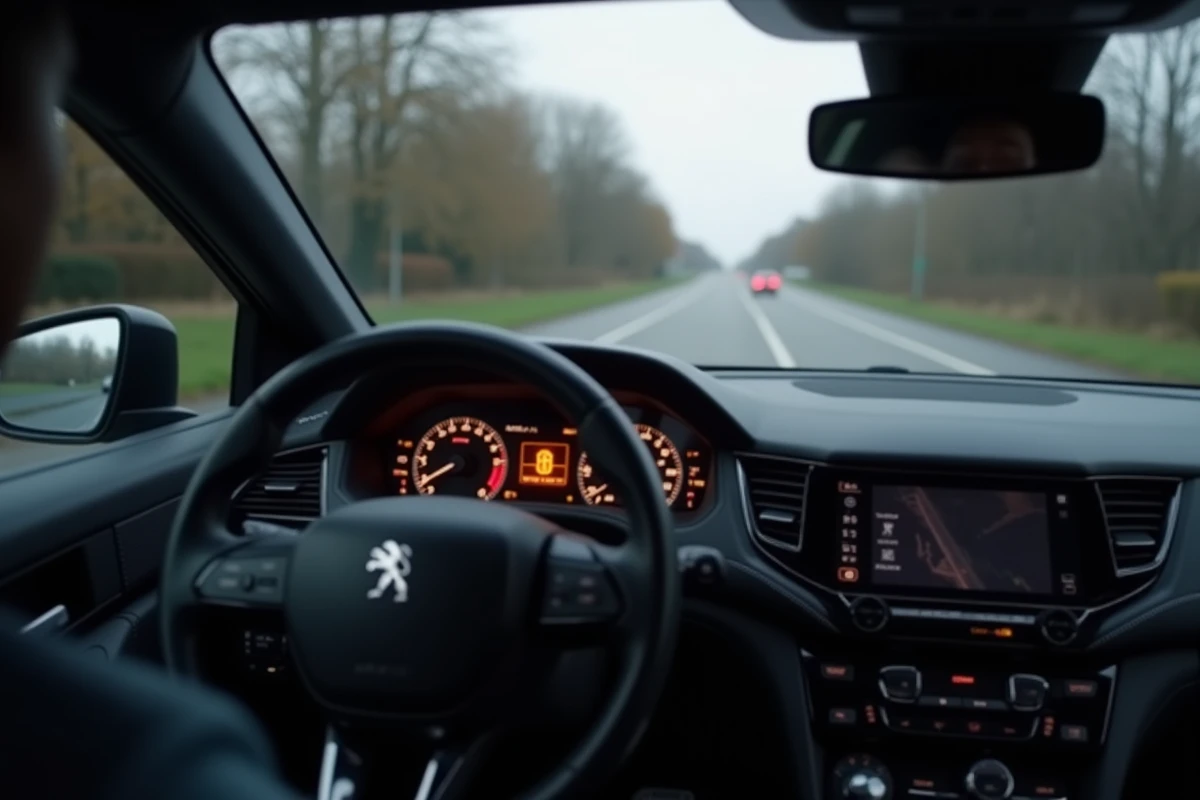
One morning, when starting your Peugeot 5008, an orange warning light comes on the dashboard. No loss of power, no strange noises, nothing tangible. The natural reflex is to keep driving, hoping it will turn off. On recent models, this type of alert often hides a fault code recorded by the computer, even when the vehicle’s behavior seems normal.
Fault code P2562 and turbo on Peugeot 5008: an underestimated case
Among the most documented orange alerts on the 5008, the code P2562 regularly appears. It concerns the position of the variable geometry of the turbocharger. Specifically, the computer detects that the turbo blades are not positioning as expected.
On BlueHDi engines, this fault sometimes manifests without any perceptible symptoms while driving. The engine runs, power seems to be there, but the orange warning light stays on. One might think it’s nothing serious. The problem is that the code P2562 can mask a gradual clogging of the turbo, especially on vehicles that frequently drive in the city at low RPM.
The repair ranges from a simple cleaning of the variable geometry valve to a complete turbo replacement, depending on the wear condition. Before incurring costs, a diagnostic check allows you to confirm whether the fault is mechanical or purely electronic (faulty position sensor). To better understand the meaning of orange warning lights on Peugeot 5008, it is essential to first identify the exact code stored in the computer.
Orange warning light on 5008 in leasing: residual value and warranty
For drivers in long-term rental (LLD) or leasing, a non-critical orange warning light poses a different problem than for a regular owner. The vehicle must be returned in a compliant state, and a warning light on at the time of return almost always results in a penalty.
The difficulty arises from the fact that some alerts do not trigger coverage by the manufacturer’s warranty. A faulty tire pressure sensor, an anti-pollution warning related to clogging of the particulate filter after prolonged urban use: these situations are common, but Stellantis often classifies them as routine maintenance rather than a manufacturing defect.
This puts you in a gray area. The warning affects the vehicle’s residual value upon return, but the repair cost remains the tenant’s responsibility. On specialized forums, feedback varies on this point: some dealers agree to address the issue as a goodwill gesture, while others charge the full cost of the intervention.
- Document each warning with photos and diagnostic reports as soon as it appears, to create a history in case of disputes at return.
- Have a pre-check performed by an independent mechanic a few months before the end of the lease, to anticipate necessary corrections.
- Keep all routine maintenance invoices (oil change, particulate filter, AdBlue), as they prove that the clogging is not related to a maintenance issue.
Batteries and electronics on PureTech hybrid 5008: extended diagnostics
On the PureTech e-DCS6 versions that appeared from 2024, another type of orange warning light is making headlines. Owners of hybrid 5008s report random black screens and system alerts at less than 10,000 km. The vehicle is nearly new, but the diagnosis can sometimes take several weeks at the dealership.
The problem seems related to the load on Stellantis networks: when the diagnostic network is overloaded, the technician cannot finalize the update or reset procedure for the computer. The vehicle remains immobilized in the workshop without active repair, which is particularly frustrating for a model under warranty.
In these cases, the orange warning light does not necessarily indicate a mechanical failure. It rather signals a software conflict between different electronic modules. Updating the computer’s firmware often resolves the issue, but the dealer must have access to the Stellantis server at the right time.
Water infiltrations and false contacts: an unknown cause of phantom warning lights
On the 5008 II (from 2017), recurring reports indicate water infiltrations through the roof antenna seal. Humidity accumulates in the cabin, causing condensation in winter, and may eventually reach electrical connectors.

When a connector oxidizes or a false contact occurs, the computer records a fault code and turns on an orange warning light. One then looks for an engine problem or a faulty sensor, while the real cause is an infiltration that a repositioned seal can easily correct. Some owners have resolved the issue with a DIY seal, but this repair is not covered by the extended Stellantis warranty.
Before replacing a sensor or an electronic module, it is worth checking the condition of the roof seals and looking for signs of moisture under the headliner or around the dome light. A complete diagnostic check will not detect an infiltration, only its consequences on the circuits.
Diagnostic of the orange warning light on Peugeot 5008: the right method
The most cost-effective reflex when facing an orange warning light is to read the fault codes with an OBD-II scanner. Consumer-grade scanners read generic codes (P0xxx series), but specific Peugeot manufacturer codes (P1xxx series and beyond) require a PSA/Stellantis compatible tool.
- Read the fault codes and note their exact reference before any intervention, to avoid random parts replacements.
- Clear the code after reading: if the warning light returns in the following kilometers, the fault is confirmed and active.
- Check the AdBlue level and the condition of the particulate filter before suspecting a mechanical issue, as these two elements generate the majority of orange alerts on BlueHDi.
An orange warning light on the Peugeot 5008 does not call for the same response depending on whether you are an owner, a tenant in LLD, or a driver of a recent hybrid model. Identifying the precise fault code, checking peripheral causes like humidity, and anticipating the impact on the vehicle’s return: these three reflexes avoid most unpleasant surprises.