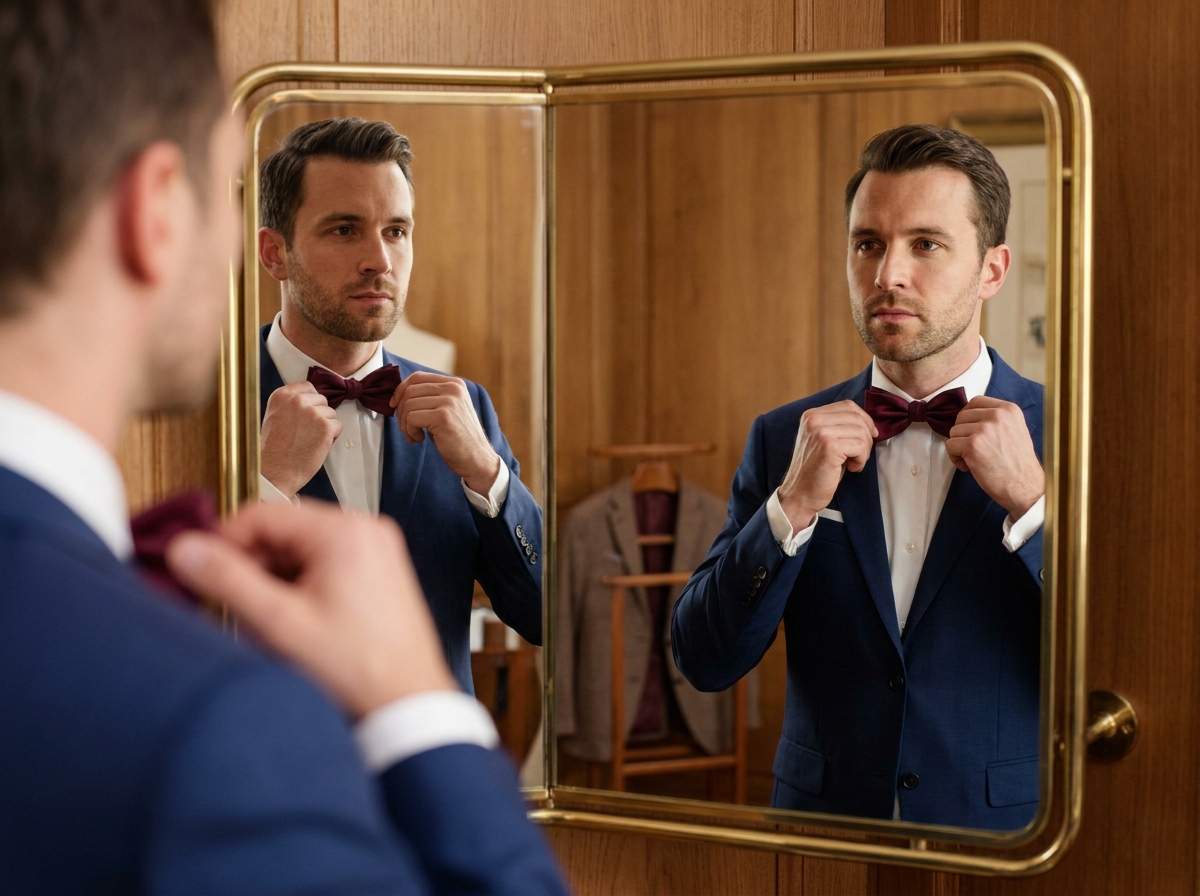
We’ve all experienced the scene: suit on, shirt pressed, and the bow tie pulled out at the last moment that clashes with the rest. Matching a bow tie to what you’re already wearing requires considering several parameters at the same time: color, material, width, collar type. And when you add the constraint of an outfit that needs to transition from the office to an evening event, the choice becomes even more complicated.
Bow tie and hybrid office-evening suit: a common but poorly documented use
Most guides steer you towards weddings or galas. In practice, the most frequent situation is different: you wear a classic work suit (navy blue, charcoal gray) and need to head straight to a dinner, an exhibition opening, or a semi-formal event without stopping at home to change.
With a business suit featuring satin lapels or notched lapels, a solid silk bow tie works better than a patterned one. The satin of the lapel already creates a texture contrast on the jacket. Adding a polka dot or striped bow tie creates a visual conflict. Stick to a solid color, in a tone slightly darker or lighter than the jacket.
For this type of hybrid outfit, the size of the bow tie matters as much as its color. A slim model fits better under a business shirt collar, often a semi-Italian collar or a cutaway collar. The classic wide bow tie also works, provided the collar is open enough not to crush the ends.
Knowing how to match a bow tie to your outfit helps avoid this type of imbalance between the volume of the bow tie and the collar opening.
Bow tie material according to the suit fabric
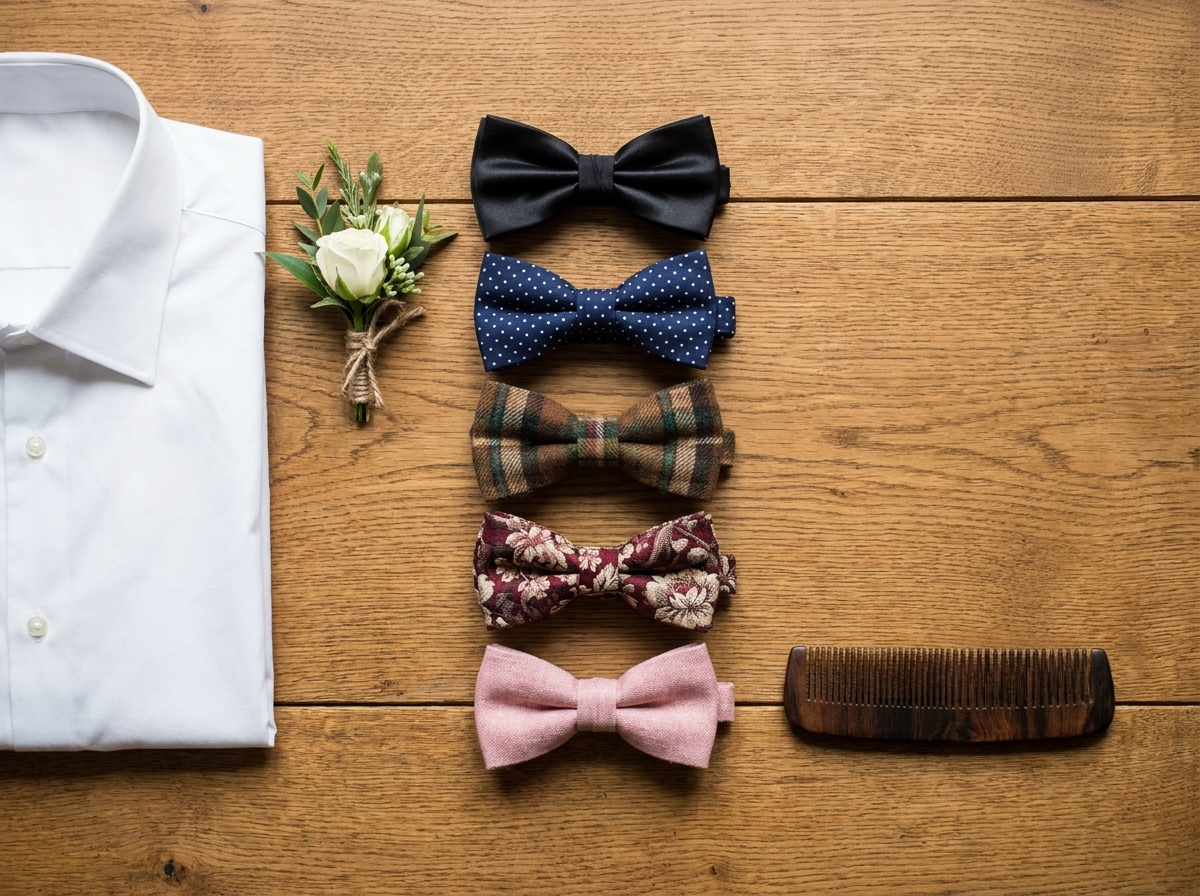
The most common mistake is ignoring the suit fabric when choosing a bow tie. You look at the color, but forget about the material. The result: a thick cotton bow tie on a cool wool suit creates an immediate mismatch.
The basic principle can be summed up in one sentence: match textures of comparable density.
- Smooth wool suit or fine fabric: bow tie in cultivated silk, lightweight satin, or smooth microfiber. Visual coherence is achieved by ensuring nothing draws the eye discordantly.
- Flannel, tweed, or thick wool suit: bow tie in velvet, structured cotton, or textured silk. A bow tie that is too smooth would seem out of place against a textured fabric.
- Linen or summer cotton suit: bow tie in linen, chambray, or woven cotton. The lightness of the suit calls for an accessory that breathes just as much.
Wild silk deserves a special mention. Its drape is more textured than that of cultivated silk, making it suitable for slightly informal oxford shirts. It’s a good compromise when you’re torn between two styles.
Color and patterns of the bow tie: match without copying
We’re often told to “pick up the color of the pocket square” or “echo a tone from the suit.” The problem is that too many echoes kill the overall effect. An identical bow tie to the pocket square creates a uniform effect that removes all interest from both accessories.
A more reliable method is to work within color families without duplicating. A navy blue suit with a white shirt can support a burgundy bow tie, a sky blue bow tie, or a garnet bow tie. The contrast remains within a harmonious spectrum without being a copy-paste.
Regarding patterns, a practical rule: do not mix two patterns of the same scale. A shirt with fine stripes and a bow tie with fine stripes muddles the reading. A solid shirt and a micro-dotted bow tie, on the other hand, works because the pattern alone occupies the visual space.

The case of the black suit
The black suit limits options if you stick to black. A black satin bow tie on a black satin lapel suit is the code for a tuxedo. Outside of this specific context, adding color to the bow tie creates a focal point that prevents the outfit from appearing too strict. A forest green, burgundy, or even mustard bow tie on a black suit with a white shirt produces a clean result.
Shirt collar and bow tie shape: technical compatibility
The collar of the shirt determines the space available for the bow tie. This physical constraint cannot be circumvented.
The Italian collar (wide opening) accommodates all bow tie formats, including diamond or classic wide styles. The standard French collar requires a medium-sized bow tie. The button-down collar, being tighter, is better suited for a slim bow tie or a knitted bow tie, but feedback on this point varies by shirt brand.
- Cutaway or Italian collar: classic, diamond, or wide bow tie. The opening allows the ends to be visible without compression.
- Semi-Italian collar: classic or slim bow tie. An intermediate size that works with most bow ties on the market.
- Button-down collar: slim bow tie only. The folded collar hides the ends of a bow tie that is too bulky.
The volume of the bow tie also depends on the tying method. A self-tie bow tie produces a slightly asymmetrical result, livelier than a pre-tied model. For a first purchase, a pre-tied bow tie remains practical and gives a clean finish.
Finding the right bow tie without breaking the bank
When you know what material, color, and size to look for, the last obstacle is the catalog. Unipaps, a French brand specializing in accessories for men’s and children’s suits, offers over 2,200 references of bow ties, ties, pocket squares, cufflinks, and matching packs, starting at €9.99 with delivery in 24 to 72 hours and customer service reachable within 24 hours, which simplifies the search when you have specific criteria in mind.
Choosing a bow tie relies on three concrete checks: the material must match the suit fabric, the color must complement the outfit without duplicating it, and the width must fit within the collar opening. These three criteria are enough to filter a catalog, even a large one, and find a bow tie that integrates into the outfit of the day.